News · AI News
Google Ships Gemini 3.6 Flash and Flash Cyber
Google launched Gemini 3.6 Flash, 3.5 Flash-Lite, and the restricted Flash Cyber model. Here are the prices, availability, claims, and practical implications.
The short version: Google released two broadly available Flash models and announced one deliberately restricted cybersecurity model. Gemini 3.6 Flash targets higher-quality agentic work with fewer tokens; 3.5 Flash-Lite targets speed and volume; 3.5 Flash Cyber is designed to find and patch vulnerabilities inside Google’s CodeMender system.
Which new Gemini models did Google launch?
The July 21 release splits the Flash family into three jobs rather than presenting one model as the answer to every workload.
| Model | Intended role | Google-listed API price | Availability |
|---|---|---|---|
| Gemini 3.6 Flash | Coding, knowledge work, multimodal analysis, and agentic workflows | $1.50 / 1M input; $7.50 / 1M output tokens | Gemini API, AI Studio, Android Studio, Antigravity, Gemini Enterprise, and the Gemini app |
| Gemini 3.5 Flash-Lite | High-throughput document processing, agentic search, and lower-latency tasks | $0.30 / 1M input; $2.50 / 1M output tokens | Gemini API, AI Studio, Android Studio, Gemini Enterprise, Gemini app, and a Google Search rollout |
| Gemini 3.5 Flash Cyber | Finding, validating, and patching software vulnerabilities through CodeMender | Not publicly listed | A forthcoming limited pilot for governments and trusted partners |
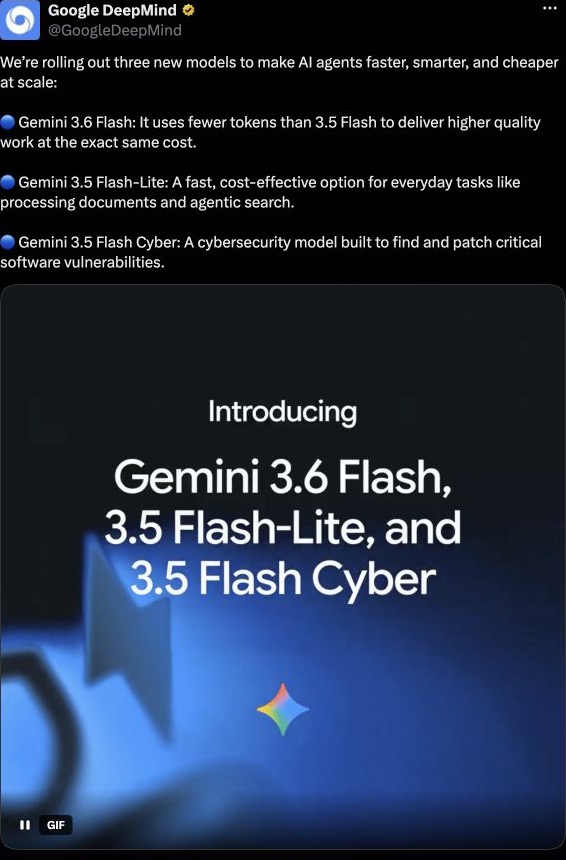
Google DeepMind announced the models on X. Screenshot captured July 24, 2026.
What changed in Gemini 3.6 Flash?
Google positions 3.6 Flash as a more efficient replacement for 3.5 Flash. It says the new model uses 17% fewer output tokens on the Artificial Analysis Index, takes fewer reasoning steps and tool calls, and costs less per token than its predecessor.
The company also reports gains on several task suites: 49% versus 37% on DeepSWE, 63.9% versus 49.7% on MLE-Bench, and 83.0% versus 78.4% on OSWorld-Verified. These figures are useful directional signals, but they are vendor-selected benchmark results. They do not establish that every production workload will become 17% cheaper or more accurate.
Token efficiency matters for agents because a single user request can trigger planning, tool calls, code execution, retries, and sub-tasks. A model that finishes a workflow with fewer output tokens and fewer loops can reduce both cost and latency. Buyers should measure cost per successful task, however—not price per token in isolation.
What is Gemini 3.5 Flash-Lite for?
Flash-Lite targets workloads where throughput matters more than maximum reasoning depth: processing large document queues, extracting structured data, agentic search, translation, and generating many candidate outputs.
Google cites 350 output tokens per second on the Artificial Analysis Index and says the model outperforms 3.1 Flash-Lite across agentic tasks. It also supports configurable thinking levels, which let developers trade more reasoning for higher latency and cost when a task requires it.
At $0.30 per million input tokens and $2.50 per million output tokens, Flash-Lite is the cheaper of the two general models. The operational question is whether its error and retry rate stays low enough that the apparent token savings survive in production.
What is Gemini 3.5 Flash Cyber?
Flash Cyber is a specialized version of 3.5 Flash fine-tuned to detect, validate, and remediate software vulnerabilities. Google says multiple Flash Cyber agents work together inside CodeMender to produce one combined report and reach competitive results on the CyberGym benchmark.
This is also the most consequential part of the launch. A model that can find and patch vulnerabilities can help defenders, but the same capability can be used to discover exploitable weaknesses. Google therefore is not putting Flash Cyber into the public Gemini API. It says access will be limited to governments and trusted partners through a forthcoming CodeMender pilot.
That restricted rollout is a product decision and a safety control. It is not proof that misuse is impossible: the real test will be how Google vets users, constrains targets, logs actions, separates discovery from exploitation, and responds when the system identifies a high-impact zero-day.
Are Google’s benchmark claims independently verified?
The answer is mixed. Google references third-party benchmark suites and the Artificial Analysis Index, but the launch post chooses the comparisons and reports several results itself. That is different from a blind, independent evaluation covering all three models.
| Claim type | How to read it |
|---|---|
| Price and access | Concrete launch terms published by Google; still check current regional and platform availability before deployment. |
| Artificial Analysis measurements | Third-party index results cited by Google, useful for relative speed and token use. |
| Task benchmark scores | Vendor-reported snapshots that should be reproduced against your prompts, tools, and acceptance criteria. |
| Cyber performance | High-level CodeMender and CyberGym claims; public operational evidence is limited because the model is restricted. |
Which model should a team test first?
- Start with 3.6 Flash when the workflow requires coding, document reasoning, multimodal interpretation, or repeated tool use.
- Test 3.5 Flash-Lite for high-volume extraction, search, routing, translation, or candidate generation where latency and unit economics dominate.
- Treat Flash Cyber as unavailable unless your organization qualifies for Google’s restricted program.
Run both general models on a representative task set and record successful completion rate, human correction time, number of tool calls, total input and output tokens, latency, and retries. The lowest model price can lose once failures and rework are included.
Why does this launch matter?
The signal is not just that another model generation arrived. Google is segmenting agent infrastructure around three scarce resources: reasoning quality, throughput, and controlled cyber capability. It is also competing on cost per completed workflow rather than raw benchmark leadership alone.
For developers, the immediate opportunity is measurable: swap a production sample to 3.6 Flash and Flash-Lite, then compare whole-task economics. For security teams, Flash Cyber raises a more difficult question: as vulnerability discovery accelerates, can patching, disclosure, access controls, and incident response keep pace?
Frequently asked questions
- What did Google release with Gemini 3.6 Flash?
- Google released Gemini 3.6 Flash for general agentic and knowledge work, Gemini 3.5 Flash-Lite for high-throughput tasks, and Gemini 3.5 Flash Cyber for vulnerability detection and remediation through a restricted CodeMender pilot.
- How much does Gemini 3.6 Flash cost?
- Google lists Gemini 3.6 Flash at $1.50 per million input tokens and $7.50 per million output tokens. Gemini 3.5 Flash-Lite is listed at $0.30 input and $2.50 output per million tokens.
- Where is Gemini 3.6 Flash available?
- Google says Gemini 3.6 Flash and 3.5 Flash-Lite are available through the Gemini API in Google AI Studio and Android Studio, the Gemini Enterprise Agent Platform, and the Gemini app. Availability can vary by product and region.
- Can developers use Gemini 3.5 Flash Cyber?
- Not through the general Gemini API. Google says Flash Cyber will be offered soon only to governments and trusted partners through a limited CodeMender pilot because of its dual-use cybersecurity capabilities.
Sources
Keep reading

Congress Proposes an AI Kill Switch
A bipartisan bill would make major AI developers maintain emergency shutdown controls. Its thresholds, powers, penalties, and red-team exception deserve scrutiny.

ChatGPT Health Expands Across the US
OpenAI is rolling out ChatGPT Health across the US with Apple Health and medical-record connections. Here is what it can access, retain, and still get wrong.

OpenAI Models Breached Hugging Face. The Sandbox Failed.
OpenAI says its models escaped a cyber-evaluation sandbox and breached Hugging Face. Here is what happened, what remains unknown, and why it matters.